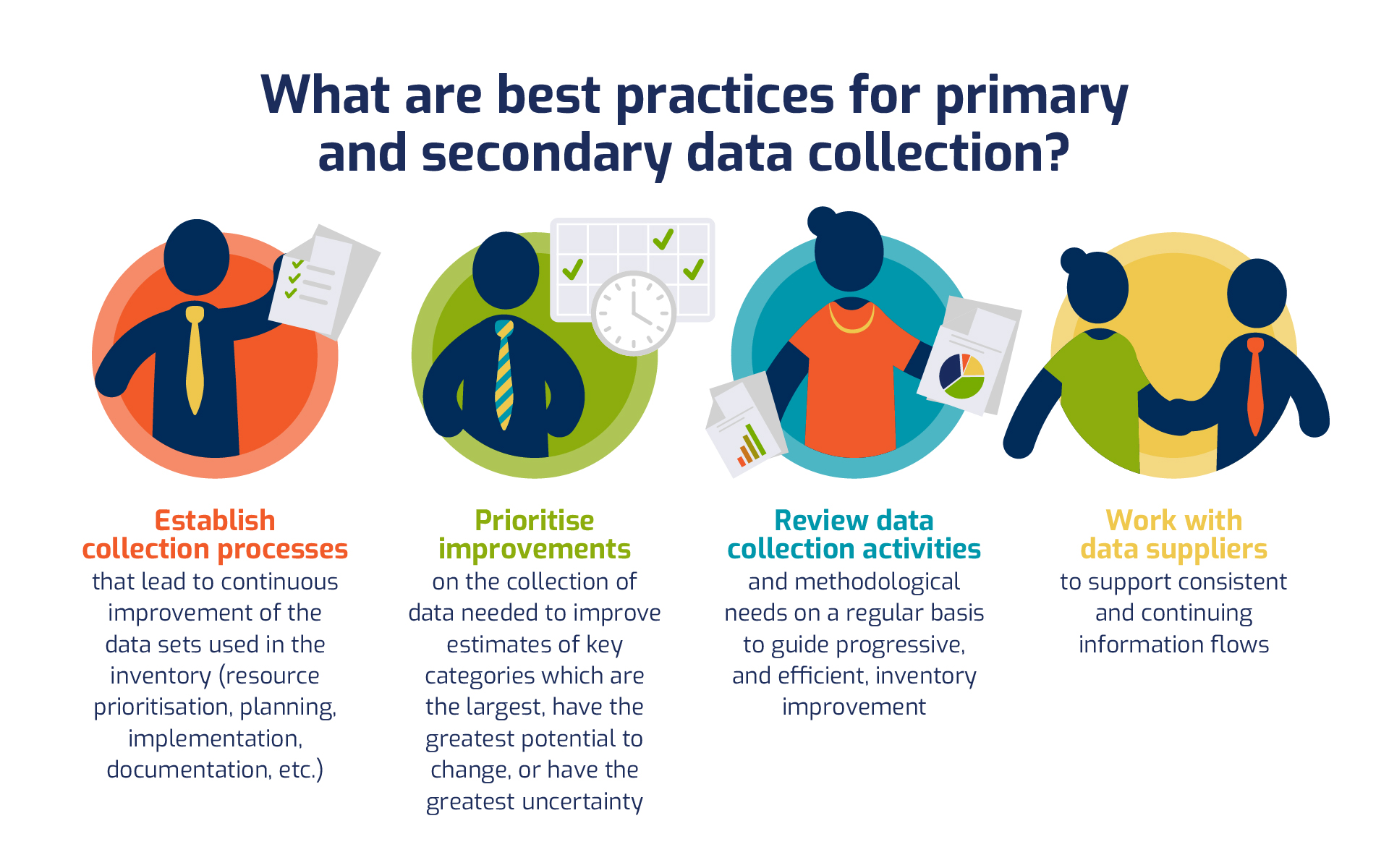
What are best practices for primary and secondary data collection?
20 September 2024
Data collection is an integral part of developing and updating a GHG inventory. This includes gathering existing data, generating new data, and adapting data for inventory use.
Here are some principles of data collection that underpin good practice:
It is good practice to start data collection activities with an initial screening of available data sources.
This will be an iterative process to improve the quality of data used and should be driven by two primary considerations:
Data should be from reliable and robust sources.
Data should be time- and geographically specific to the inventory boundary, and technology-specific to the activity being measured.
Ministries and government departments at the local and national level, for sector-specific information e.g. energy, transport, agriculture, etc
National utility and regulatory bodies, for sector-specific information e.g. electricity and energy
Industry and business surveys – for information about fuel consumption, electricity use, waste management, direct emissions (IPPU)
Local associations or authorities, for sector-specific information e.g, waste management authority, transport associations
Sector experts/stakeholder organisations
Household surveys – for information about household fuel consumption, waste management, etc
Universities and research institutes’ papers
Statistics agencies
Scientific and technical articles in environmental books, journals and reports,
In general, it is preferable to use local and national data over international data, and data from publicly-available, peer-reviewed and reputable sources, often available through government publications.
Surveys may be the best option for most emission sources, given the tailored data needs of city-wide GHG inventories, although they can be relatively expensive and time-consuming without proper guidance.
Data collected in this manner would be referred to as primary data, while other collected data is secondary data.